Why Denominations, especially Confessional Denominations, are Good for Us
Almost every major denomination in America is and has been losing membership for some time, including the Missouri Synod, and the trend is likely to continue. The primary beneficiaries of all these losses are so-called “non-denominational” churches. Many Christians in America are simply switching to non-denomination churches. In fact, even some denominational churches are removing their denominational titles from their name and otherwise downplaying their denominational associations. All this is very consistent with the highly individualistic spirit of our age and our culture. I have heard many a spirited defense of non-denominational churches, that they are preferable, and more biblical, than denominational congregations—after all, “there are no denominations in the Bible.” That statement, although it means nothing, is practically a creed among the non-denominational churches!
This trend toward non-denominational churches is not a healthy one for Christians who want to have and maintain a solid Biblical, orthodox faith. While it is indeed sad that there is a need for denominational divisions among Christians, that being the case it is a very good thing that denominations such as our own exist. So, I’m going to give a spirited defense of denominations generally, and in particular, of our own denomination.
First, let’s begin by acknowledging that the Christian Church is One, Holy and Apostolic. There is one Christian Church, it belongs to God, and what is believed and taught and practiced in that one Christian Church must bear the stamp of the apostles Jesus sent into the world. Christians are not free to conceive of Jesus and the Kingdom of God however they want. So how is a Christian supposed to know that what they are being taught to believe is truly apostolic? All Christians want to follow the Bible, and all churches say they do follow the Bible. How is a Christian then to judge?
Join me in a thought experiment. What can we say about an individual who wants to be a Christian, but who has no association with a Christian congregation, who is self-taught from first to last simply by reading the Bible, who worships in their own way according to their own conscience and their own reading of the Bible, and who is answerable to no one but Jesus (as they understand Him) for their beliefs and practices? I will not pass judgment on whether this person is or is likely to be saved. I will only say this: Theirs is almost certainly a very idiosyncratic faith, probably unlike the faith and practice of any other Christian on earth. It is unlikely to be very “apostolic”, and it is a dangerous place for a person who wants to be a Christian to be.
Follow me a little further. Now let’s take that same person and plug them into a stand-alone congregation, a congregation with no associations with any other congregations, past or present, a congregation which searches the Scriptures on its own and determines for itself what they mean. In other words, let our previously stand-alone individual be stand-alone no more! Instead, let them learn about Jesus from our stand-alone congregation, and worship in the same way and along with the others in that congregation. Let them be answerable instead for how they believe not to themselves alone, but to this stand-alone congregation. Chances are good that what that individual person ends up believing and how they put their beliefs into practice will be much less idiosyncratic than when they were when they were completely on their own, because their faith will be tempered by the belief and practices of all the others in the congregation. Two heads are better than one, and there is safety in numbers. But this individual may still be in a very dangerous place, because individual, stand-alone congregations can be very idiosyncratic too. A congregation like that will do what it thinks is best, to be sure, what it thinks is most Biblical. But if it’s wrong, there are no other congregations to reign it in, to temper its eccentricities. So the individual in this position who wants to be a faithful Christian is at the mercy of the stand-alone congregation to which they are attached, and whether that stand-alone congregation is apostolic in the teaching and practice.
Now let’s take that stand-alone congregation and plug it into a larger organization, a congregation, if you will, of congregations, and let our previously stand-alone congregation stand-alone no more. Let it instead submit itself to the judgments and insights and wisdom of all those other congregations. Now we have another layer of protection for our individual who wants to be an orthodox Christian and wants to know that what they are being taught is truly Biblical and apostolic. Just as an individual them self is tempered and limited, so to speak, in how eccentric and idiosyncratic they can become, because of the influence of their congregation, so also their congregation is tempered and limited in how eccentric it can become by the influence of the other congregations with which it is associated.
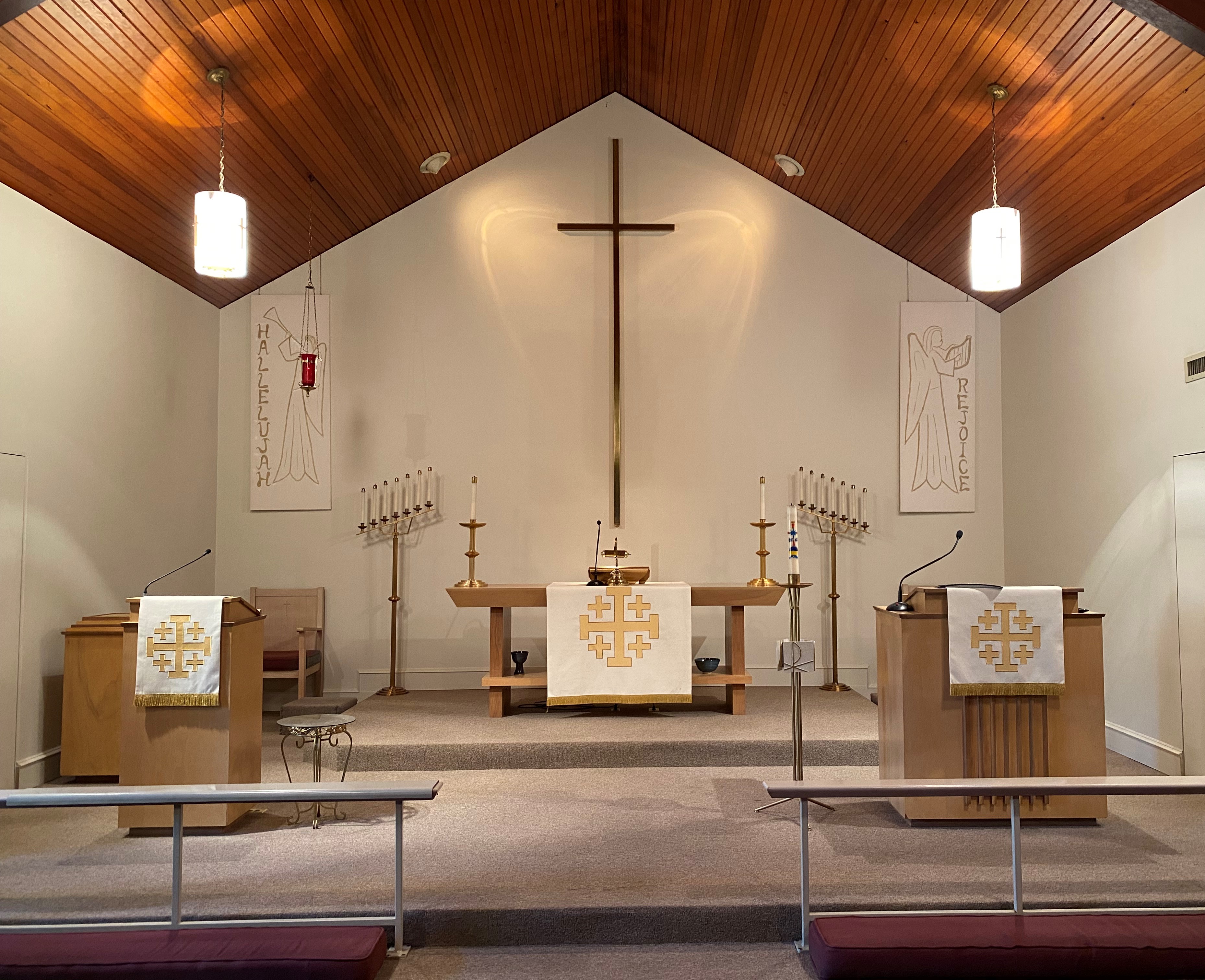
First Lutheran Church in Benton is not a stand-alone congregation, but is a part of a larger collection of congregations, called a synod. “Synod” means “Walk together.” Our synod is a denomination, and we are proudly a part of it. The members of First Lutheran Church in Benton don’t interpret the Scripture all on their own, but are guided by the influence of the whole congregation, which itself is guided by the influence of the other congregations of the synod to which we belong, that is, the Lutheran Church—Missouri Synod.
But, you may ask, what keeps the whole synod from becoming eccentric and unapostolic? Being a part of a denomination by itself is no guarantee of apostolicity. Just as surely as a stand-alone congregation can abandon apostolicity and go its own way, so can an entire denomination do the same—and take all the congregations and people who belongs to it with it! A denomination must not stand alone either. And, in fact, the Missouri Synod does not stand-alone. It cannot do as it pleases; it is part of a larger thing, the “Lutheran Church” (which is not actually a “church” at all, but a theological system). As such, the Missouri Synod is guided and tempered by whatever it means to be “Lutheran”.
In other words, our denomination, the Missouri Synod, doesn’t get to make up what a “Lutheran” is. The doctrinal statements of the Lutheran Church, also known as the Book of Concord, or the Lutheran Confessions (by which is meant, Confessions of Faith), were assembled between 1526 and 1580, and they detail what a Lutheran is. So, long before there was a Missouri Synod, there was already such a thing as a Lutheran. The Missouri Synod, and therefore the congregations which make up the Missouri Synod, and therefore also First Lutheran Church in Benton, are guided and limited by these documents, they are guided and limited by what it means to be a Lutheran.
And these Lutheran Confessions are not stand-alone either. Martin Luther and the other Reformers were not free to fashion whatever teachings they liked and call them apostolic. What these documents say did not hatch out of their minds, to be sprung on the Church for the first time in the sixteenth century. Just the opposite. These confessions of faith are very careful to show how what the Lutherans were teaching was Biblical, apostolic, and not new at all. Lutheran teaching arose squarely out of the one holy Christian and apostolic church, and those who are taught according to that teaching are being taught the apostolic faith of the one holy Church.
It is because our congregation is part of a denomination, and specifically a faithfully Lutheran denomination, that we, the members of First Lutheran in Benton, may have a great deal of confidence that the faith we are being taught to believe and practice is in fact the apostolic faith of the Scriptures and of the one Holy Christian Church. We have this confidence not because we are free to interpret the Bible on our own and for ourselves, but because we are not. We received the apostolic faith from those who came before us. We did not invent it for ourselves.
Now, a brief word about non-denominational churches. It is not entirely accurate to say that a non-denominational church is a totally “stand-alone” church. Such churches generally do not make up their own doctrines and practices. (Stay completely away from any congregation that does that!) Rather, they typically owe their theology to some, or perhaps even several, unnamed denominations. For that reason non-denominational churches are not nearly as idiosyncratic as they would be if they truly were standing alone. Even so, what those denominational backgrounds are, since they are not identified, would have to be ferreted out by the members—and few are able to do that. Furthermore, the extent to which those unidentified denominations will have preserved apostolic doctrine will vary. But a church that calls itself “non-denomination” is indeed stand-alone at least in this respect: such a congregation is not answerable to any other congregations or confession of faith. In that regard, rather than being non-denominational, they might better be characterized as denominations unto themselves.
It is sad that there are doctrinal divisions in the universal Church, but that is a fact. Rather than let every Christian fend for themselves in determining what’s Biblical and apostolic, it is better that individual Christians, congregations, and denominations submit to what has already been determined to be true and right. If the doctrine of the one holy Christian Church is apostolic, then individual Christians, congregations and denominations are to receive it, be faithful to it, and pass it on to the next generation—not find it for themselves!
 First Lutheran Church (Missouri Synod)
That should be a chapter in your upcoming book you know?!
LikeLike
Well said. I think this should be a chapter in your book.
LikeLike