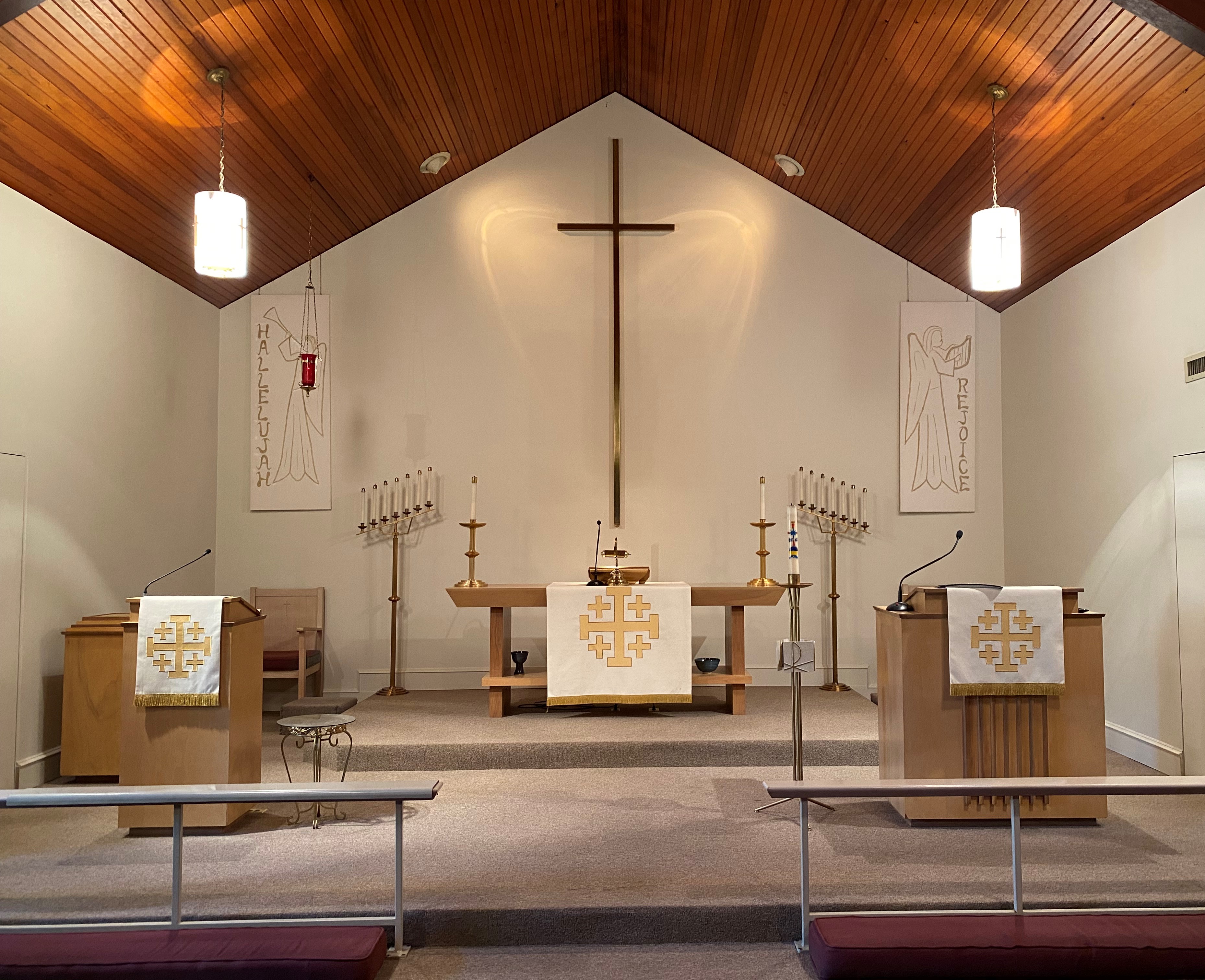
At the most basic level, a congregation exists to nourish its members with the Word of God, and to provide a home for Christians in the Church, a place of safety, encouragement, comfort and joyful fellowship.
Preaching and Teaching of the Word of God and the Administration of the Sacraments
First Lutheran Church is organized around the Word of God. This means more than that we teach according to the Bible–although we certainly do teach according to the Bible! It’s important to understand what the Word of God is. The Bible is the Word of God, but the Word of God is more than the Bible. The Word of God comes to us in human words: written, read, spoken, sung, prayed, or even thought words. It also comes to us in certain actions. Baptism, for example, is the Word of God in the form of a holy washing, while the Sacrament of the Altar is the Word of God in the form of a holy meal. Absolution is the act of forgiving the sins of the repentant just as Christ Himself commanded the Church to do. The Bible is not only read, but is also used to tell us when other spoken, sung, written, read, thought or prayed words, or when certain actions are, in fact, the Word of God.
Human words can be powerful on their own, for example when they are persuasive or inspiring or enlightening. The Word of God has another kind of power besides that, a divine power, because it brings with it the Holy Spirit. Where the Word of God is, there also is the Holy Spirit at work. For this reason we refer to the Word of God as the “Means of Grace”, in other words, it’s the physical instrument that God uses to touch us and to deliver to us the Holy Spirit, so that we might belong to Christ and be His disciples. Without the Holy Spirit there is no faith in Christ, no forgiveness, no life, and no salvation, no discipleship.
The Holy Spirit works through the Word of God giving that Word a special power not found in ordinary words, power to convict and condemn, and, more importantly, power to forgive and make alive. The Word of God by which the Holy Spirit convicts we call the Law. The Word of God by which the Holy Spirit forgives and makes alive we call the Gospel. The Holy Spirit works through both the Law and the Gospel to work in Christians daily repentance and new life.
It is the Word of God that connects the disciple to Christ. Without the Word, there is no Holy Spirit at work in us. Without the Word, there can be no discipleship. If a disciple abandons the Word, that disciple will wither and die. That’s what it means that the Word of God is the means of grace, and that’s why the Church is organized around the Word of God. To be organized around the Word of God is to be organized around Jesus Christ by the power of the Holy Spirit.
The purpose of First Lutheran Church is to make the Word of God available in all its forms so that the members of First Lutheran may be and remain in regular contact with Jesus Christ, to the end “that they may be His own and live under Him in His kingdom, and serve Him in everlasting righteousness, innocence and blessedness.”
Divine Services
Most basically, through the regular worship of the congregation, called the Divine Service. The Divine Service (known among Roman Catholics as the Mass, and among some protestants as the Eucharist or Service of Holy Communion) is held every Sunday morning. It involves two chief parts. The first part, called the Service of the Word, may be compared to sitting at Jesus’ feet to be taught by Him. Appointed Scriptures are read, and are also explained and applied to the gathered disciples. The appointed readings themselves constitute what is called the lectionary. Three readings are appointed for each Divine Service, a reading from the Old Testament, a reading from one of the Epistles, and the most important reading, from one of the Gospels. These readings are organized around the life and teachings of Jesus and together are designed to present the whole counsel of God over the course of a year. For example, approximately half the year focus on readings relating to Jesus’ coming, his incarnation and birth, His early Galilean ministry, His journey to Jerusalem and the cross, his resurrection, His ascension into heaven, and the outpouring of the Holy Spirit on His disciples. The second half of the year is devoted to various teachings that Jesus gave to the church. The readings repeat every three years. The very design of this part of the service assumes, and requires, the regular participation of the disciples. A single isolated service simply cannot present the whole counsel of God to the disciples and those that attend only sporadically are not being adequately grounded in the Word of God.
The second part of the Divine Service, called the Service of the Sacrament, involves an intense focus on the central act of Jesus’ life and ministry, what is called the Atonement. To make atonement for the sins of the world though his death on the cross is why Jesus was sent by the Father into this world and how Jesus becomes our Savior. This part of the service may be compared to an entering into the “upper room” to be with Jesus and His Disciples the night before He was crucified, or perhaps to a standing before Jesus as he is being crucified, and there to contemplate of the power and meaning of His crucifixion. Unlike the Service of the Word, this part of the service changes very little from Sunday to Sunday, and always involves the eating and drinking of the very Body and Blood of the Lord Jesus, the very Body and Blood which was given and shed for us for the forgiveness of our sins. The focus here is not learning from, but touching Jesus.
Teaching
The Divine Services and other worship services of the congregation are designed primarily to focus the devotion of Christians on the Lord Jesus and His work. Teaching and learning happen in the Divine Service, of course, but the focus is on the worship of the Lord. Classes are taught also, on Sunday mornings and most Wednesday evenings. These classes treat a variety of topics, and are more focused on increasing understanding of Scripture, various theological topics, or matters of interest to the members.
Sunday morning classes typically, though not always, focus on some aspect of the readings appointed for the day which will not be developed, or at least not developed as fully, in the Divine Service. Sometimes the Bible class will survey the various readings, hymns, prayers and other components of the upcoming worship service to increase the worshippers’ appreciation of the service. Additionally, there is often an overlap in themes or subjects addressed in the morning Bible class and the worship service which follows it. The idea is that members who spend the full morning in the Word, first attending the Bible class, and then the Divine Service, will receive a richer and fuller presentation of the Word than those who only attend the worship service.
Wednesday evening classes are longer and tend to go rather more in depth than Sunday morning classes. They are taught each Wednesday from 7:00 pm to 8:15 pm, except during Advent and Lent, when special services are held instead, or in the months of July and August.
Catechesis
Christians, to be healthy and effective disciples, need to know a lot of things about the Father, the incarnation and atoning death of His Son, and the work of the Holy Spirit. On top of that, Christians must understand the kingdom of God, and the life that Christians are called to live in that kingdom and the future we have to look forward to. It is also often the case that people wishing to be Christians must unlearn many things they thought they already knew!
While being a Christian does not require a person to be a scholar about all things Biblical, there is a certain core set of things every Christian really needs to know and understand. Instruction in these core teachings is what is often called “catechesis”. At a minimum, this involves instruction in the “Six Chief Parts” of the Small Catechism: The Ten Commandments, the Apostles’ Creed, the Lord’s Prayer, the Sacrament of Baptism, Confession and the Sacrament of Absolution, and the Sacrament of the Altar. Catechesis is offered on an individual basis, and from time to time as a small group class. This instruction is designed to answer questions, to prepare for Baptism, to prepare to receive Holy Communion, and to bring every disciple to at least a minimal understanding of the Christian faith.
Baptism
First Lutheran Church recognizes “one baptism for the remission of sins”. We therefore recognize the baptisms of all Christians baptized into the Name of the Triune God, Father, Son and Holy Spirit, whether in a Lutheran Church or not. We do not “re-baptize” those who come into the Lutheran Church having been baptized already in another trinitarian denomination, nor do we “re-baptize” those who have been properly baptized already but, for some reason, wish to repeat the act. This includes those who were baptized as infants.
On that point, Lutherans are not only willing to baptize infants, but insist upon it. God makes no promise of salvation, even to infants, apart from Baptism. Therefore, Christian Parents or other adults with authority to do so are to bring their infants to be baptized as quickly as possible. Baptism is not a “stand alone” event or a merely cultural observance. It begins a life with Christ in his Kingdom and culminates in the resurrection of the dead and the life of the world to come. Therefore, we do not baptize anyone, even infants, where there is no intention of continuing in the faith. Quite the contrary, it is assumed that infants who are baptized will be brought to worship weekly and carefully instructed in the Christian faith as they grow up. This is the most solemn responsibility of parents!
Whether infants, children, or adults, baptisms normally are performed during the Divine Service. This is not an absolute requirement, however. For various reasons, exceptions can be made. There is no exception, however, to the requirement that a believer in Christ be baptized.
Pastoral Care
The pastor of First Lutheran is charged to preach and teach the Word of God in its truth and purity and to administer the sacraments according to the word of God. This involves not only the publicly conducted teaching and worship services of the church, but also the private ministry of the Word in the homes of the members. This is especially important for members who are not able to attend worship regularly, and for any member in times of special joy or illness or distress. For the most part this is on request. he won’t, as a rule, just show up unannounced. The pastor visits at the birth of a child, or the death of a loved one. He will visit members in the hospital, or in their homes. He will offer counsel and guidance from the Word before important decisions. He is also available to commune privately those who are unable to attend public worship for an extended period of time, or to pray for and with the people according to their needs.
The pastor is also charged by God to “pay careful attention to [himself] and all the flock, in which the Holy Spirit has made [him] overseer.” Acts 20:28. Therefore, he wants members to contact him proactively when they are in need of pastoral care. Moreover, he does pay attention when members miss worship unexpectant and may very well try to contact such members to learn why–if, that is, they don’t contact him first, which is better by far!
Marriages
The pastor will joyfully conduct pre-marital counseling and perform marriage services where such ministry is reasonably a part of his call to serve the First Lutheran congregation. As a practical matter this requires that either the future husband or wife are already a member of the congregation, or have the intention to become a member of the congregation. In general, marriage ceremonies for members of First Lutheran are expected to be conducted in the sanctuary, and will be conducted according tot he established orders of the church. Individuals who are co-habiting will be required to repent of that, and such repentance is likely to require the forming of separate residences until the marriage is solemnized.
Funerals
It is expected that the pastor will conduct funeral services for congregation members, and it is expected and hoped for (though not required) that such services be conducted in the sanctuary rather than at a funeral home. Services for non-members may be conducted also, especially if requested by a member.
Congregational Home Life
First Lutheran Church, in addition to nourishing its members with the Word and Sacraments, also provides a home for them, a place to form relationships with other Christians, to be encouraged by them, to learn from them and with them, and to join with them in service to the Kingdom. This aspect of Christian living, a gift of God by which He strengthens our faith, is sometimes called “the mutual conversation and consolation of brethren.” (SA III. iv).
Because First Lutheran is operated by its members, there are many opportunities for its members to be involved, from assisting in various ways in the Divine Services, to the maintenance of the church’s building and property, from serving in an administrative leadership position to informally bringing a meal to a potluck or to a member in need. The congregation needs, and provides many opportunities, for its members to serve each other and our Lord with their time, skills, energy and money. Such opportunities include:
Before worship: Altar Guild, cleaning of the sanctuary, preparation of bulletins, pre-service preparations.
In Worship: Ushering, greeting, reading, singing, instrumental performance, assisting with the recording and live-streaming.
After worship: Greeting of visitors, preparation of attendance record, contacting of visitors.
Sunday School: Teaching classes, assisting.
Special Situations: Calling upon the ill or grieving, preparation of meals for the ill or grieving, providing rides to and from worship, assisting members in various needs.
Property Maintenance: Regular yard work and mowing, occasional Work Days, occasional repairs, construction or renovation projects.
Administrative Positions: Chair, Vice-Chair, Secretary, Treasurer, Financial Secretary, Chair of Board of Elders, Chair of Board of Properties.
Read more about the obligations of members to God and to the congregation
 First Lutheran Church (Missouri Synod)