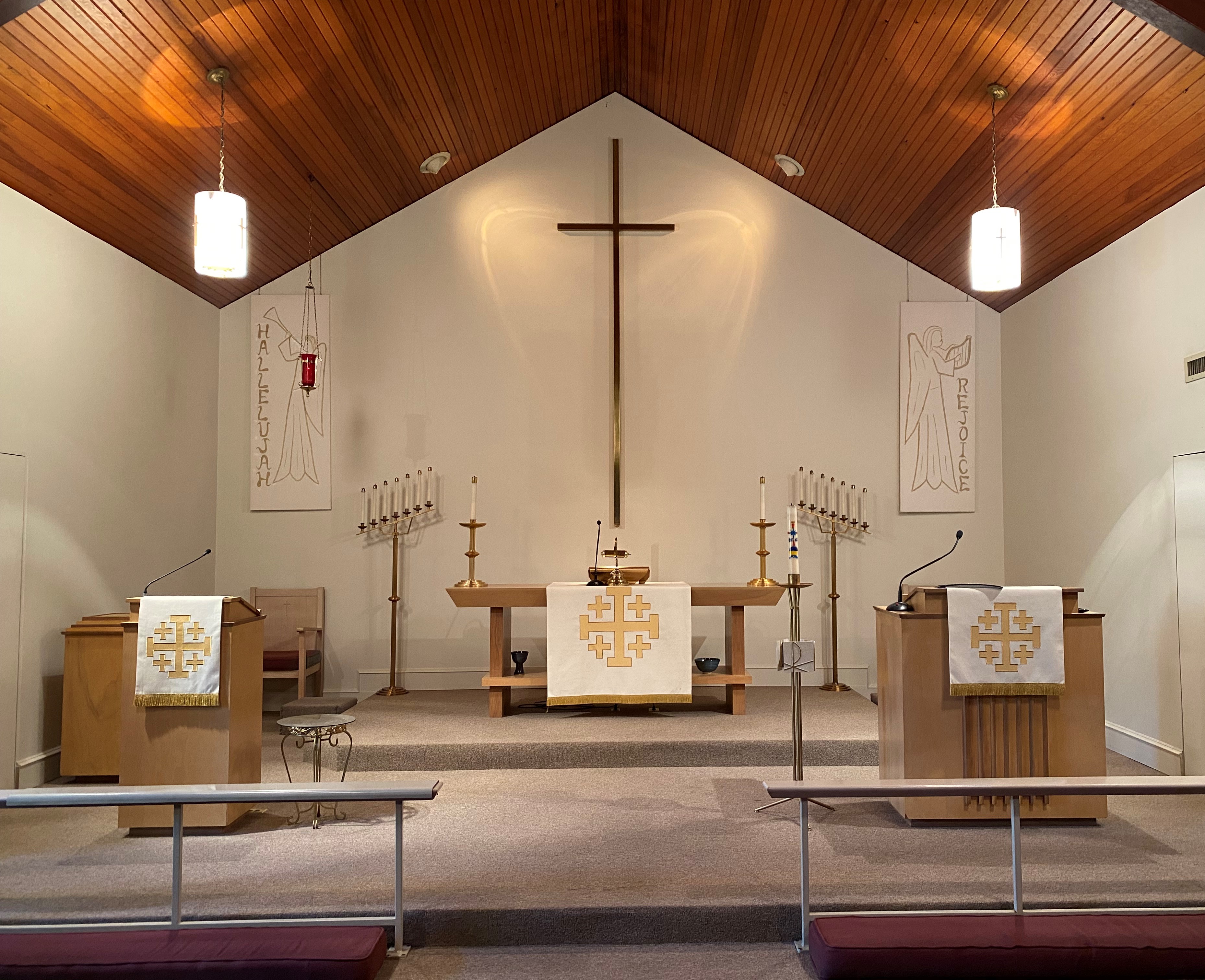
Because I, Pastor Burns, now have time enough to work on this sort of thing, FLCBenton.com is under rapid development! Please visit the site, poke around, and tell me what you think, and anything you would like to see added or changed. It ought to work on any computer, tablet or smartphone. If you are a member of the congregation, bookmark the site, because i believe it will become an important part of the congregation’s ministry. “Follow” the website and you will automatically receive posts to the site when they are made. If you comment on any of the posts, keep it short and simple until I figure out how this works. Meanwhile, be patient with me as I learn the secret arts involved in website design and functionality.
The Most Important Words
The Words of Institution are the most important words ever spoken. They are about the most important thing that ever occurred. They are spoken by the most important person who ever lived. The Words of Institution are about the meaning of the death of Jesus, and they are delivered by Jesus Himself within hours of that event.
They are not the only explanation of Jesus’ death. The Jewish leaders believed that the death of Jesus was first of all because he was a false prophet and a blasphemer, and the judgment of God on a false prophet and blasphemer was death. The leadership also believed that Jesus, perhaps unwittingly, was upsetting the delicate political balance between the Jews and the Romans. Whether He meant to or not, Jesus was risking a bloodbath if He was not stopped. As a result, and sadly perhaps, it had become profitable “for one man to die so that the whole nation might not perish.” Those are two explanations of the meaning of Jesus’ death.
The Romans, or at least Pontius Pilate, thought differently. Pilate did not believe that Jesus actually deserved to die. He had to die, though, because of the nature of the times and of the place in which He lived. Sometimes the cost of keeping the peace for all falls heavily on some, or in this case, on One. It’s rough justice, to be sure, but sometimes that is the best that can be done. That was the Roman view of Jesus’ death.
Modern thought sometimes focuses on Jesus as an obedient servant of God, a hero of faith and faithfulness, who demonstrates his unwavering commitment to the Father by submitting quietly to injustice and even to death. Jesus’ death is meant as an example to us all as to the radical commitment faith demands.
Or sometimes modern thought sees Jesus’ death as little more than an accident. Jesus did not intend to die, but things got out of hand. In this view, Jesus’ death really had no special meaning, other than perhaps that bad things sometimes happen to good people.
The Words of Institution are Jesus’ own explanation of what His death was about. They are the definitive explanation: “My Body and My Blood are being given and shed for you. They are being given and shed for the forgiveness of sins. The forgiveness of sins is the New Testament in my blood. That is, my death will seal, will ratify forever, my intention to forgive your sins.”
There is another level of understanding to the Words of Institution. That level concerns not the meaning of Jesus’ death, but the establishment of a sacred meal to commemorate it. In instituting the sacred meal, Jesus said, “Take; eat.” He said, “Drink of it, all of you.” He said, “Do this, as often as you drink of it, in remembrance of me.” The things we are to eat and drink are His “body” and His “blood”, which are about to be given and shed for the forgiveness of sins. The words “My Body” and “My Blood” are where the institution of the meal and the meaning of the cross intersect. In other words, it is the very same body and blood which was given and shed at the cross, which is also being offered in this meal for us Christians to eat and drink. “Given and shed” refers to the cross and death; “eat and drink” refer to the meal; both pairs of words refer to the same Body and Blood of Christ.
“In remembrance of me” specifically refers to the meaning of Jesus’ death as He Himself explained it. To eat and drink with any other understanding of the meaning of His death is not to do so “in remembrance” of Him.
The Words of Institution are the most important words ever spoken. They are about the most important thing that ever occurred. They are spoken by the most important person who ever lived. The Words of Institution are about the meaning of the death of Jesus, and they are delivered by Jesus Himself. The Church is built on these words. It strands or falls on these words. Everything done or spoken by God to us before leads to them; everything done or spoken by God to us after flows from them. And by faith in these words everything we do now is done in remembrance of Him.
Does Baptism “Save”? And if it Does, Does it Save Infants?
Some Christians believe it is wrong to speak about Baptism “saving”. They say that only Jesus saves, that Baptism is only an action commanded by Christ, that it is meant to be an outward sign of the believer’s faith, and that it is at most, perhaps, also a sign of what the Holy Spirit accomplishes invisibly within a repentant believer. These Christians usually also deny the appropriateness of baptizing infants, since, among other reasons, infants cannot confess their faith in Christ.
These questions cannot be meaningfully addressed in isolation. We also have to consider the Gospel, faith in general, saving faith, believing, trusting, thinking, loving, perishing, and being saved
Perishing and Rescue
We begin with the problem: For whatever reason, the natural state of each and every living thing is that it is perishing, and will certainly perish, unless rescued. No living thing is safe on its own. No living thing is exempt. Without rescue, every living thing perishes, sooner or later, one way or another. This is the natural state of all living things, including people, no matter their age, moral qualities, innocence or worth, and it is well confirmed by the experience of life. There is no physical evidence, or logical reason, to believe otherwise.
The Word of God confirms this dreary assessment. Everything is perishing. But, it adds, “Whoever calls on the name of the Lord will be saved.”
At its most basic level, then, being rescued from perishing is what it means to be saved.
The Gospel and the Nature of Faith
Faith does not mean we believe in God, but rather that we believe God when He speaks. When God makes a statement of fact, we believe it is true—because God does not lie. When God makes a promise, we trust and rely on it, because God is faithful and keeps his promises. The Gospel is both representations of fact, and promises. It contains such representations as that God, out of his great love for us, sent His Son to us, who died for us, who rose for use, and who now lives and reigns for us. These representations we believe are true. The Gospel contains promises as well: “I will be with you always”; “He who believes and is baptized shall be saved”; “Whoever comes to me I will never turn away, and I will raise him up on the last day”, etc. These promises we trust.
Together, believing and trusting in these representations and promises is what is called “saving faith”. Of course, saving faith does not save. Christ saves those who call upon Him. Saving faith means you know who Christ is, and what He has promised, and so you call upon Him.
Whether Salvation is ever possible without Faith
It does not appear that anyone will be saved without faith. To put that another way, no one will be saved because of who they are descended from, or how old they are, or how principled they are, or how open minded, or tolerant. Christ saves those who call upon Him, and without faith no one calls upon Him. That’s not to say that God cannot save someone without faith, but if he has any plan to do so, He has not revealed it. On the other hand, he has said specifically, “He who does not believe will be condemned”.
Whether an Infant can have Faith
Can an infant have faith? This is really the same question as, Can an infant can be saved? If no one can be saved without faith, and infants can be saved, then infants must be able to have faith. If infants cannot have faith, and no one can be saved without faith, then infants cannot be saved. Scripture never says any class of people are saved without faith. Nor does it say that any class of people are unable to be saved because they’re incapable of faith.
The problem with believing that infants can have faith is often less a problem with what we believe about infants and more what we believe about faith. The more we understand faith as a cognitive activity, the harder it is to see how an infant can do it. But if faith is viewed emotionally and relationally, and not just cognitively, things get easier. Love, for example, has cognitive, emotional and relational aspects to it. Most people would agree that an infant is capable of loving and trusting its mother, even when much too young to cogitate about anything. A mother does not teach her infant child. A mother holds her child, touches her child, feeds her child. The love comes naturally, without any teaching, without any appeal to the child’s thinking mind. As the child grows, so does the cognitive aspect of its love for its mother, and words and understanding become more and more important.
We are comfortable letting an infant love its mother within the confines of what an infant can do. We do not insist that the infant be able to think about it. It just loves. At age ten, we expect a more three dimensional love than at 6 months, because a ten-year-old is capable of so much more cognitively. A ten year old who loves his mother will also think about her, too.
Faith likewise has cognitive, emotional and relational aspects to it, and like love, we will do well if we let an infant have faith in God within the confines of what an infant can do, without denying the essential character of that faith. As the child grows, so too will the cognitive aspects of its relationship with God, until that faith becomes something more recognizable—and communicable—to us grown-ups.
What it means that something “saves”
Christ alone saves. He saves those who believe and trust in Him. But it is impossible to believe in Christ if you have never encountered Him. Therefore, we often speak of the things which bring us Christ, so we can believe and trust in him, as “saving”. So, the Gospel saves, because it brings us Christ. Without Christ, we cannot believe in him and cannot be saved. On the other hand, prayer does not save. Pray as much and as earnestly as you like, and unless your prayer is addressed to Christ it accomplishes nothing. And if it is addressed to Christ, it can only be that the Gospel has already saved you!
How Baptism Saves
Now we can see how it is that baptism saves. It is an encounter with Christ, and gives us something to believe in that can save. Baptism is a message from God. More specifically, it is a promise from God. It is, actually, the very same promise as that of the Gospel. The Gospel itself is the message about the person and work of Jesus Christ. Part of the Gospel (a rather important part, I should say), is the promise that the Gospel “works the forgiveness of sons, rescues from death and the devil, and gives eternal salvation to all who believe this.”
The promise of the Gospel is typically made in spoken or written words, whereas the promise in Baptism is made through the action of the washing God commanded. The promise (whichever form it takes) works, so to speak, because of Christ’s death, resurrection and ascension—and because God is faithful and keeps his promises. Whichever form it takes, though, “It works the forgiveness of sons, rescues from death and the devil, and gives eternal salvation to all who believe this.”
Faith is not in words we hear or a washing we see and feel. It is in the work of Christ, which we don’t see and which we don’t feel, but which is delivered to us in audible words or through a tangible washing. To put it another way, one does not believe in the power of the washing itself, but in the power of the thing signified by that washing; just as one does not believe in the power of the words of the Gospel themselves (a if they were a kind of incantation), but in the power of the thing spoken of by those words. The thing signified, the thing spoken of, is the living Christ, who made atonement for our sins.
Furthermore, the Holy Spirit accompanies the promise, in whichever form it is made, making faith in the promise, in whichever form it is made, possible. Whether the promise is made by words or by an action, the one to whom the promise is made has what is promised–when, that is, by the power of the Spirit which accompanies the promise, they believe the promise.
Baptism Saves infants Too
We must face facts. If no one is saved without faith—and Scriptures gives us no reason to believe that anyone is—then Infants are either lost (perish the thought!) or they are capable of faith and being saved. They are not capable of reason or self-examination. They cannot ask Jesus into their lives or confess Him as their personal Lord and Savior. They are, on the other hand, more than capable of being touched, of being loved, and of being adopted. Now for an adult, to be touched, loved and adopted by God is a powerful thing, cognitively as well as emotionally. To be washed free of your sins and given the promise of everlasting life in Christ—in other words, to be Baptized—naturally is accompanied by confessions of faith and promises on our part to follow, not to mention hymns and prayers and joy and thanksgiving. But the Baptism is one thing—it’s what God does—while the confessions of faith and the promises to follow and the joy and the thanksgiving are another. They are what we do. We do them because, in Baptism, God is speaking to us and touching us, and because we’re old enough and cognizant enough to do that sort of thing.
Infants are not old enough to respond like adults to God’s voice or touch, but they are old enough to be spoken over by God and touched by Him. They are old enough, then, to be saved; they are old enough, then, to be Baptized.
Faith Doesn’t Save
“Faith” by itself is meaningless. No one just has “faith”. “Faith” has to be in something. So, to speak intelligently of faith, we must speak both of the act of believing, and in the thing believed. People believe things. They don’t just “believe”.
According to the Scripture, “saving faith” does not save because it is faith, like somehow there is something about the act of believing that causes a person to be saved. What saves about “saving faith” is the thing believed.
And, according to Scripture, what is the thing believed? The “thing believed” is not that God exists. Common sense, not faith, will tell a person that God exists. Obviously God exists, or we wouldn’t be here to ponder that. But God has also spoken. And not just spoken, either. He has said some remarkable things, things which we could never have known, could never have guessed, things which the human mind could never, on its own, imagine.
The Gospel is such a thing that God has spoken. It is a remarkable thing. It is a “thing to be believed”. It is a promise from God, that He will save those who believe it. Faith doesn’t save; God saves. And Saving Faith is not “believing in God”; it is believing God. God promises to save those who trust that Jesus is their Savior. Why should anyone believe that? Because God has said so. Believe Him! And you will be saved!
The Gospel
“I am not ashamed of the Gospel,” Paul said, “for it is the power of God for the salvation of everyone who believes” (Rom 1:16). The Gospel is the power of salvation. Not the Bible, not Scripture, but the Gospel.
On the Last Day, “everyone who calls on the name of the Lord will be saved.” Paul again, citing Joel (Rom 10:13). The Gospel involves calling on the “Name of the Lord”. That’s something else than merely “believing in God”, or vaguely praying to whatever mysterious God, if any God at all, might be out there. Calling on God’s Name means calling on a God Who has made something about Himself known, something that gives the caller on God a reason to expect an answer. To put it another way, God’s Name is what is known about God, and the Gospel is the most important thing we can know about Him. It’s the reason a person might call upon Him for salvation, and might, having called upon Him, actually expect to be saved. Without the Gospel, a person might well enough cry out to God–why not? “Any port in a storm,” as they say. But just because a person asks for something from God, doesn’t mean they should expect anything from Him.
The Gospel is the Word of God about Christ (Rom. 10:17), and what He did, and what He does, for those who need saving. Through the ages God has spoken many, many words to humanity, and they are all, each and every one of them, infallibly true. Some of these words He caused to be written down as Scripture. They are just as infallibly true–and more lasting. But God’s words have no power to save just because they are true, or just because they come from the mouth of God Himself. They have power to save when they concern Christ, and what He did, and what He does, for those who need saving. God’s Word about Christ, that is, the Gospel, is alone the power of God to save. It is the reason we may expect–actually, that we may know–that God will save those who call upon Him.
 First Lutheran Church (Missouri Synod)